The turn of October and November is a time when many cultures celebrate those who have passed away. This time is particularly reflective and nostalgic, but it also brings back inspirational stories of role models from both the recent and distant past.
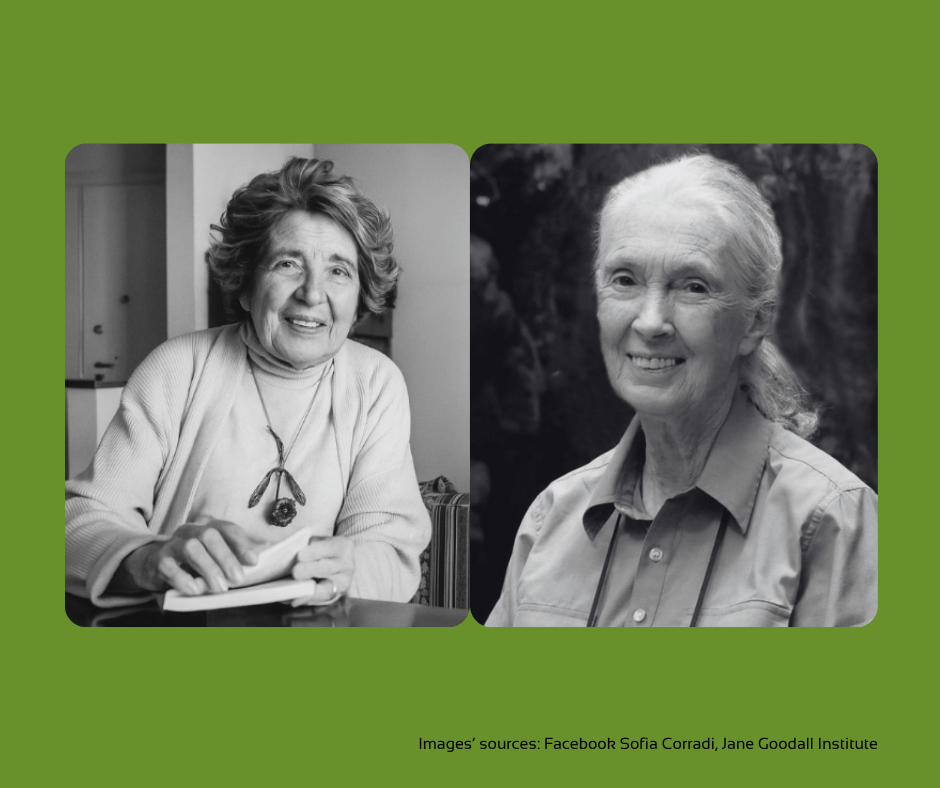
Many wonderful minds passed away in 2025, including some of the most prominent women leaders. In recent weeks, we were particularly touched by the news of the passing of two wonderful women, whose contribution to the world directly relates to Amazons Project. In this reflective season, our team remembers Jane Goodall and Sofia Corradi, known as Mamma Erasmus.
Who were they, and why do we find them so important?
Jane Goodall should be a role model for anyone working in social impact, especially in environmental care.
You may know her from heartwarming videos of releasing animals, particularly apes, back to the wild. Chimpanzees hugging Jane and thanking her, before leaving to where they belong…
This is merely a symbolic representation of Jane’s values and impressive heritage in her work for animal welfare, but also for social justice, human rights, and the general wellbeing of our planet. Among her most impactful projects, she founded Jane Goodall Institute and served as the UN Messenger of Peace, promoting peacebuilding and care for environment – both social and natural.
She strove to remain inspirational and accessible to diverse groups of people, including youth in important discussions, and always considering the voice of those unprivileged. She was known for respecting local cultures and building her knowledge and conducting her research with aboriginal practices and wisdoms in mind.
“Jane was passionate about empowering young people to become involved in conservation and humanitarian projects and she led many educational initiatives focused on both wild and captive chimpanzees. She was always guided by her fascination with the mysteries of evolution, and her staunch belief in the fundamental need to respect all forms of life on Earth.” – we read in the Institute’s memorandum dedicated to Jane.
Jane remains among women who inspire projects like ours. She enabled the discourse of women leaders in the conservation and humanitarian work, positioning female leadership as equally bold in its gentle character, focus on relationships and bonds, and closeness with nature. She demonstrated that these features can go hand in hand with action, entrepreneurship, and empowerment.
One of the programmes that we encourage our young audiences to check is Roots & Shoots – a framework for young people, “inspiring and equipping the next generation of conservation leaders.” The initiative is now active in 75 countries, bringing together volunteers who are empowered to become involved in hands-on programs to affect positive change for animals, the environment, and their local communities.
Jane Goodall passed away on the 1st of October 2025. She was 91 years old.
Sofia Corradi was not only one of the so-called Founding Mothers of Europe, but also a Mother of Erasmus Programme.
Known as Mamma Erasmus, Italian pedagogist Sofia Corradi began her journey of changing the world around her as an ambitious law student. At some point, in the late 1950s, she was given an opportunity to study at the Columbia University, known as one of the best higher education institutions in the world.
Upon her return to Italy, she was faced with criticism and lack of recognition for her studies abroad, despite the degree being very prestigious. She felt like her hard work was disregarded simply due to the idea of intrinsically imaginary borders dividing the countries on the global map.
After finishing her studies, Corradi started working on research about the right to education at the United Nations. By the time she was 30, she had become a scientific consultant for the Association of Rectors of Italian Universities, a role she earned partly thanks to her diploma from Columbia University. In that position, she began passionately promoting an idea that would later change European education: a university exchange program that allowed mutual recognition of studies between countries.
In 1969, her ideas were presented at the European Conference of Rectors in Geneva and soon after, they caught public attention through several major Italian newspapers. Not everyone was convinced at first; some skeptics even joked that sending students abroad was just an excuse to “chase blonde girls.” Corradi’s witty reply was that anyone not serious about studying wouldn’t bother taking exams, no matter where they were.
Her proposal first caught the attention of Italy’s Minister of Education and then inspired other European countries to start similar talks. In 1970s, her principles were officially recognized through a resolution by the European Economic Community that encouraged student exchanges between universities. This led to a decade of pilot programs, known as the “Joint Study Programs,” which tested the idea of credit recognition between universities.
After years of persistence, setbacks, and collaboration, that experimental model evolved into what we now know as the Erasmus Programme, launched in 1987. Because of her early and tireless advocacy, Sofia Corradi became affectionately known as “Mamma Erasmus”, the Mother of Erasmus.
Sofia Corradi passed away on the 17th of October 2025, also aged 91.
The story of Corradi was not so easy, especially because she was a woman with international mindset. Her life represents resilience that women have within themselves and the importance of value-driven action in leadership.
Mamma Erasmus is our Mamma. It feels great to know that today we use the framework, for which the foundations were laid by a strong and passion-driven woman. Without founding mothers of Europe, Amazons Project would not exist.
Jane Goodall and Sofia Corradi remind us what women’s leadership truly means: leading with care, vision, and courage.
They showed that change begins when someone dares to act from compassion: Jane through her deep respect for animals and the planet, and Sofia through her belief that education should connect, not divide, people. Their stories continue to inspire young women to lead with empathy, to nurture communities, and to stand firm for what they believe in. Through their example, we see that leadership rooted in care can shape a kinder, more sustainable world – the very essence of what the Amazons Project stands for.
 Amazons Project
Leave a comment